

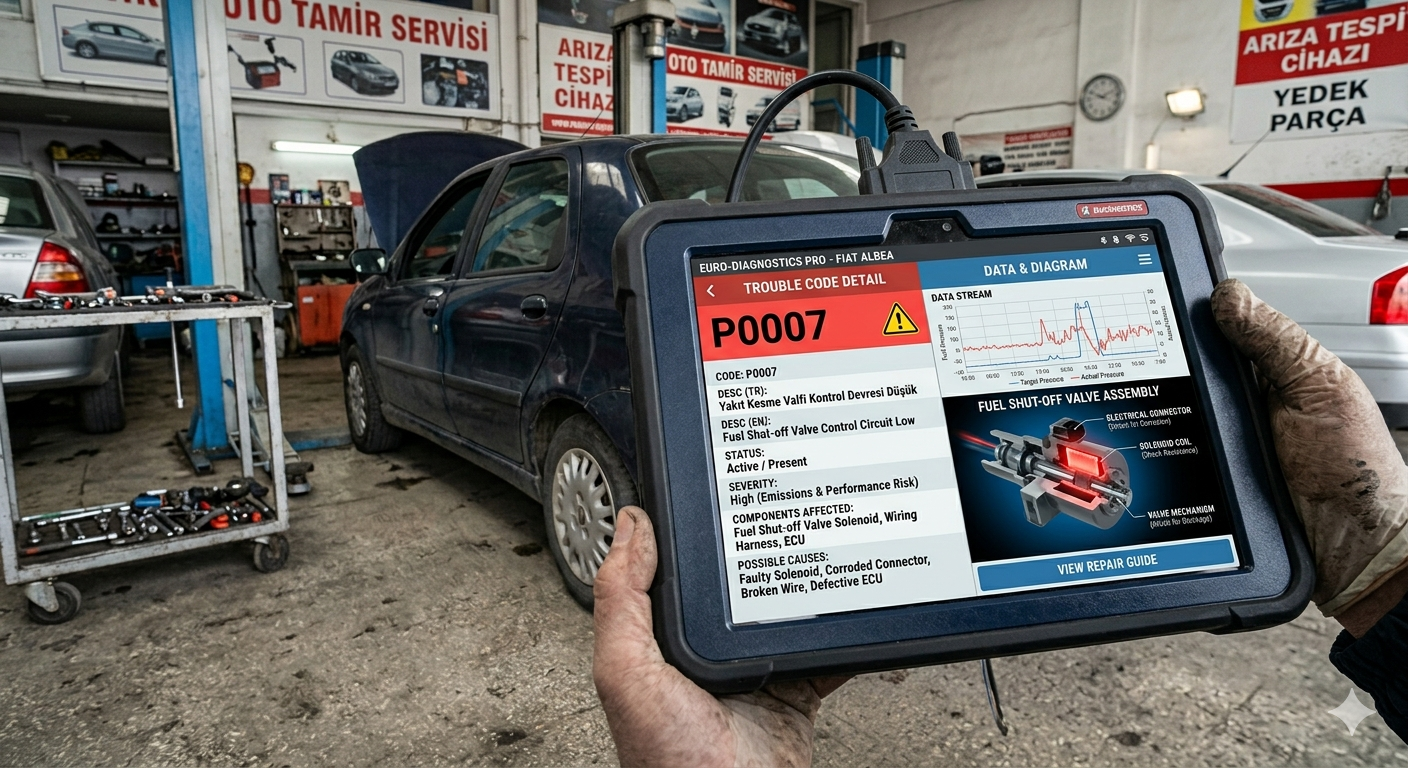
P0007 code is a diagnostic trouble code (DTC) that indicates a high-voltage condition within the fuel shutoff valve control circuit. When your vehicle’s Powertrain Control Module (PCM) or Engine Control Module (ECM) detects that the electrical signal sent to the fuel shutoff valve remains higher than the expected operating parameters, it triggers this specific fault. This valve plays a critical role in safety and engine management, acting as the primary mechanism to stop fuel flow when you turn off the ignition or during emergency events. Understanding how this system operates electrically is key to resolving the issue without wasting time on unnecessary part replacements.
- System Association: Fuel delivery and engine management systems.
- Severity Level: High; often results in a no-start condition or immediate engine stalling.
- Primary Cause: Short to voltage in the wiring harness or a failed fuel shutoff solenoid.
- Diagnostic Tool: Requires a digital multimeter (DMM) and an OBD-II scan tool with live data capabilities.
What is the P0007 Code and What Does It Mean?
To understand the P0007 code, you must first understand the purpose of the fuel shutoff valve. In many diesel engines and specific high-pressure direct-injection gasoline systems, the fuel shutoff valve is a solenoid-operated valve designed to stop the flow of fuel immediately. Unlike older mechanical systems, modern vehicles rely on electronic control to manage combustion parameters and safety shutoffs. When you turn your key to the off position, the PCM cuts power or ground to this valve, causing a spring-loaded plunger to block the fuel passage and kill the engine.
The PCM monitors the integrity of the control circuit by sending a small reference voltage through the circuit and measuring the return signal. If the return voltage is consistently higher than the calibrated threshold, the computer interprets this as a circuit high condition, leading to the activation of code p0007. This is not necessarily a sign of a failed mechanical valve; instead, it is primarily an electrical fault indicating that the circuit is receiving more voltage than it should, or that a switch inside the control unit is stuck closed.
Symptoms of Code P0007 in Your Vehicle
Because the fuel shutoff valve directly controls the supply of fuel to the injectors or high-pressure pump, any electrical failure in this circuit will produce immediate, noticeable symptoms. In most cases, you will not be able to ignore this issue, as it directly impacts engine operation.
The most common symptom is a crank-but-no-start condition. The engine starter will spin the engine, but because the shutoff valve remains closed due to the electrical fault (or because the PCM has entered a safety mode), no fuel reaches the combustion chambers. If the fault occurs while you are driving, the engine may stall abruptly, creating a potentially hazardous situation on the road.
Other symptoms include the illumination of the Check Engine Light (Malfunction Indicator Lamp) and, in some vehicles, the activation of a “limp home” mode. If the PCM detects intermittent high voltage, it may allow the engine to run but will severely limit power and RPM to prevent damage to the high-pressure fuel system. You might also notice a strong smell of unburned fuel if the valve is stuck in an open position and fuel continues to pool in the lines after shutdown, though this is less common than a complete blockage of flow.
Comparing P0005, P0006, and P0007 Codes
The OBD-II diagnostic system groups related circuit faults together to help technicians narrow down the nature of the electrical failure. The fuel shutoff valve control circuit is monitored by three primary codes: P0005, P0006, and the P0007 code. Comparing these codes helps clarify why your scanner is reading a “high” circuit fault rather than an open or low fault.
| DTC | Circuit Condition | Typical Electrical Cause | Engine Behavior |
|---|---|---|---|
| P0005 | Circuit Open | Broken wire, blown fuse, or disconnected harness plug. | Immediate no-start; valve cannot be energized. |
| P0006 | Circuit Low | Short to ground in the control wire, pulling voltage down. | No-start or erratic stalling; valve fails to open fully. |
| P0007 | Circuit High | Short to battery voltage or internal solenoid short. | No-start, valve stuck closed, or potential ECM driver damage. |
As shown in the comparison, code p0007 is distinct because it involves an excess of voltage on the control line. While a P0005 indicates a complete break in the path, and P0006 indicates that the electricity is escaping to the vehicle’s chassis ground before reaching the valve, P0007 means that voltage from another source is feeding into the signal wire, or the solenoid’s internal resistance has dropped to near zero, causing excessive current draw.
Common Causes of a P0007 Code
Pinpointing the root cause of a P0007 code requires looking closely at the vehicle’s wiring harness and the solenoid itself. Wiring harnesses are constantly exposed to engine heat, vibration, road salt, and physical wear, making them the most frequent source of electrical diagnostic trouble codes.
A common cause is a short to voltage. This occurs when the insulation on the fuel shutoff valve control wire chafes against another wire that carries constant 12-volt battery power. Over time, friction wears away the protective plastic covering, allowing the copper strands of the two wires to touch. This floods the control circuit with high voltage, bypassing the PCM’s control switch.
Another likely culprit is a failed fuel shutoff solenoid. Inside the solenoid is a tightly wound coil of copper wire. If the insulation on these internal windings breaks down due to heat or age, the electricity will bypass the coils (a short-to-self), drastically reducing the solenoid’s resistance. According to Ohm’s Law, when resistance drops while voltage remains constant, current increases. The PCM detects this high current draw as a circuit high condition.
Corrosion inside electrical connectors can also cause unusual voltage readings. Water intrusion past weathered weather-stripping seals inside the connector plug can bridge the gap between the power feed terminal and the signal terminal, mimicking a short to voltage. Finally, though much less common, a failed driver inside the PCM can cause this code if the internal solid-state switch fails in the closed position, continuously supplying power to the circuit.
How to Diagnose the P0007 Code Step-by-Step
Diagnosing electrical codes like the P0007 code requires a systematic approach. Jumping straight to replacing the fuel shutoff valve can be an expensive mistake if the real problem is a chafed wire hidden deep inside a loom. Follow this step-by-step procedure to isolate the fault accurately.
Step 1: Visual Inspection of the Harness
Begin by locating the fuel shutoff valve. It is typically mounted on or near the high-pressure fuel injection pump or the fuel rail. Carefully inspect the wiring harness leading to the solenoid. Look for signs of pinching, melting from contact with hot exhaust components, or green corrosion on the connector terminals. Unplug the connector and check the pins for tightness; loose pins can cause intermittent high-resistance connections that confuse the PCM.
Step 2: Testing Solenoid Resistance
Set your digital multimeter to the Ohms scale. Connect the meter leads to the terminals of the fuel shutoff solenoid itself (with the harness disconnected). Refer to your vehicle’s service manual for the exact specification, but most solenoids should show a resistance between 10 and 30 Ohms. If your meter reads near zero Ohms, the solenoid has an internal short and must be replaced. If it reads infinite resistance (OL), the solenoid is open, which would typically trigger a P0005, but can sometimes cause erratic PCM readings.
Step 3: Checking the Control Circuit for Voltage
With the solenoid disconnected, turn the vehicle’s ignition switch to the key-on, engine-off (KOEO) position. Set your multimeter to DC Volts. Connect the black lead to a clean chassis ground and the red lead to the power supply pin on the harness connector. You should see battery voltage (approximately 12.6 volts). Next, test the control or ground side of the connector. If you detect 12 volts on the ground-side control wire while the circuit is supposed to be inactive, there is a short to voltage somewhere in the wiring loom between the connector and the PCM.
Always refer to the specific wiring diagram for your vehicle’s make and model. Some manufacturers switch the power side of the circuit, while others switch the ground side. Misinterpreting the switching strategy can lead to incorrect diagnostic conclusions.
Step 4: Checking for Shorts to Voltage
To confirm a short to voltage, turn the ignition off and disconnect the negative battery cable. Disconnect the harness connector at the PCM. Use your multimeter to check for continuity between the fuel shutoff valve control wire and any other power source wires in the harness. If you find continuity (low resistance) between the control wire and a constant 12V wire with both ends of the harness unplugged, you have confirmed a physical short in the wiring bundle.
How to Fix Code P0007 and Estimated Repair Costs
Once you have isolated the fault, the repair process is straightforward. If the issue is a shorted solenoid, replacing the fuel shutoff valve is the only reliable solution. This involves relieving fuel system pressure, unscrewing the old valve from the pump or rail, lubricating the seals on the new valve with clean fuel, and torquing it to the manufacturer’s specifications. Always bleed the fuel system afterward to remove any trapped air, which can cause starting issues.
If the diagnostic steps pointed to a wiring issue, you will need to open the wire loom and locate the damaged section. Cut out the chafed or corroded wire, splice in a new section of the same gauge using marine-grade heat-shrink butt connectors, and re-wrap the loom with high-temperature electrical tape. Avoid using simple twist-on wire nuts or non-waterproof tape, as these will quickly fail under the hood.
Repair costs can vary widely depending on the vehicle make and whether you perform the work yourself or take it to a professional shop. A replacement fuel shutoff solenoid typically costs between $50 and $200 for the part. If you have a professional shop perform the diagnosis and replacement, expect to pay between $150 and $400 in labor. Wiring repairs are highly variable; a simple wire splice may cost $100, while tracing a complex harness issue can occasionally run higher if the dashboard or major components must be removed to access the wiring path.
Can You Drive with a P0007 Code?
Operating a vehicle with an active P0007 code is highly discouraged and often impossible. Because this code directly affects the fuel shutoff mechanism, the vehicle is likely to stall unexpectedly or refuse to start entirely. A sudden stall while driving at highway speeds represents a significant safety hazard, as you will lose power steering assist and power brakes, making the vehicle difficult to control.
Furthermore, if the code is caused by an electrical short that is forcing the valve to remain open, you run the risk of fuel flooding the engine cylinders after you turn the key off. This can dilute the engine oil with fuel, reducing its lubricating properties and potentially causing severe internal engine damage over time. If you scan your vehicle and find this code active, it is best to tow the vehicle to a repair facility or keep it parked until you can perform the necessary electrical diagnostics.
Resolving the Issue Permanently
Successfully clearing the P0007 code requires addressing the underlying electrical imbalance. Once the physical repairs are complete—whether you replaced the solenoid, repaired a rubbed wire, or cleaned a corroded connector—use your OBD-II scan tool to clear the code from the PCM’s memory. Perform a road test under various driving conditions to ensure the code does not return. Pay close attention to how the engine shuts down; it should stop instantly and smoothly without sputtering or running on after the key is turned off. Keeping your engine bay clean and ensuring wiring harnesses are securely clipped into their factory brackets will prevent physical wear from causing similar electrical faults in the future.
Frequently Asked Questions
Can a blown fuse cause a P0007 code?
While a blown fuse usually causes an open circuit code like P0005, in some complex vehicle electrical networks, a blown fuse can cause the PCM to detect an unexpected voltage drop or reference signal shift, triggering a P0007. Always check the fuel system and engine management fuses early in your diagnostic process.
Is the fuel shutoff valve the same as the fuel pressure regulator?
No, they are different components. The fuel shutoff valve is a safety device designed to completely open or close the fuel flow path, whereas the fuel pressure regulator constantly modulates the fuel pressure inside the rail to ensure optimal combustion.
Can I bypass the fuel shutoff valve to get home?
Bypassing the fuel shutoff valve is highly dangerous and not recommended. Doing so bypasses critical safety systems, meaning the engine may not shut down in an emergency, or fuel could continuously leak into the engine, causing a fire hazard or severe mechanical damage.
Why does my OBD2 scanner show P0007 as pending?
A pending code means the PCM has detected the high-voltage fault during a single drive cycle but needs to see it occur again on a subsequent drive cycle before illuminating the Check Engine Light. Treat a pending code with the same seriousness as an active code, as the fault is present.
How long does it take to replace a fuel shutoff solenoid?
For most vehicles, replacing the solenoid itself is a relatively quick job that takes between 30 minutes to an hour. However, accessing the valve on some diesel engines may require removing intake piping or fuel lines, which can extend the repair time.
