

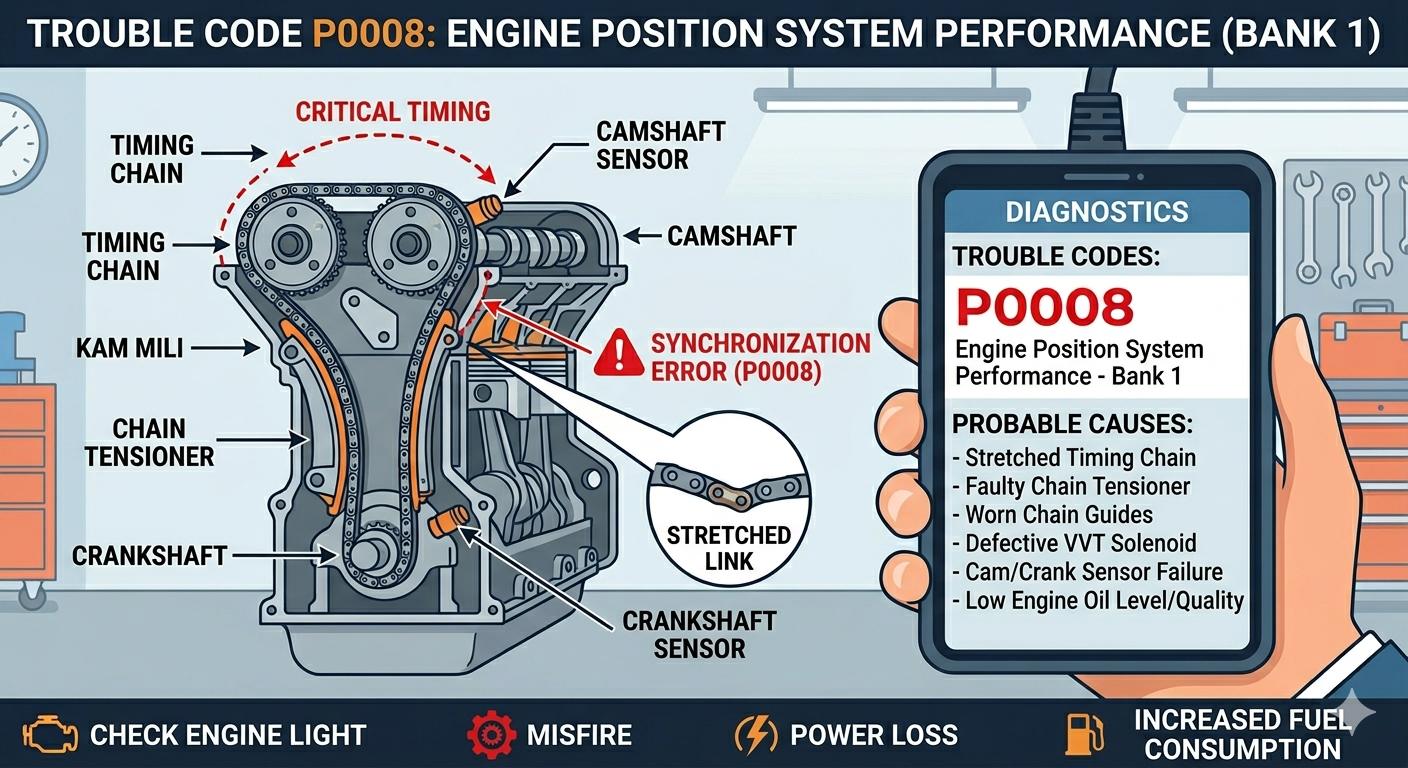
P0008 code is a diagnostic trouble code that points directly to a synchronization issue between your engine’s crankshaft and the camshaft on Bank 1. When the Engine Control Module (ECM) detects that these two vital rotating assemblies are out of alignment by even a few degrees, it triggers the check engine light. This specific code is widely known among mechanics, especially those who work on modern overhead cam engines equipped with variable valve timing. Understanding what triggers this fault can save you thousands of dollars in unnecessary parts replacements.
Key Takeaways
- Primary Cause: The most common culprit behind this code is a stretched timing chain or worn timing components.
- Bank 1 Specific: This code only refers to Bank 1 of the engine, which is the side containing cylinder number one.
- Urgency: High. Driving with this code for extended periods can lead to severe internal engine damage.
- Prevention: Frequent oil changes with high-quality synthetic oil are the single best way to prevent this issue.
What Does the P0008 Code Actually Mean?
To understand the mechanics of this fault, we need to look at how a modern internal combustion engine breathes. The crankshaft, located at the bottom of the engine, moves the pistons up and down. The camshafts, located at the top in the cylinder head, open and close the intake and exhaust valves. For the engine to run smoothly and efficiently, the movement of the pistons and the valves must be synchronized perfectly. This synchronization is managed by a timing chain or belt.
The ECM monitors this relationship constantly using the crankshaft position sensor and the camshaft position sensors. These sensors read teeth on reluctor wheels attached to the shafts. The P0008 code, which officially stands for Engine Position System Performance (Bank 1), is set when the ECM detects that the camshaft on Bank 1 has fallen out of step with the crankshaft. This is not a sensor failure code; rather, it is a performance code. It means the sensors are working fine, but they are reporting a genuine physical misalignment between the mechanical parts.
On V-style engines (like V6 or V8 configurations), Bank 1 refers to the bank of cylinders that houses cylinder number one. If you have an inline engine (like an inline-4 or inline-6), there is only one bank, so any timing alignment issue will typically trigger a Bank 1 code. The physical misalignment detected is often microscopic, but because modern engines rely on precise valve timing to optimize fuel economy and reduce emissions, even a deviation of a few degrees will trigger the diagnostic system.
Why Does the P0008 Code Trigger? Common Causes Analyzed
While a variety of factors can cause the crankshaft and camshaft to lose their synchronization, certain mechanical failures are far more common than others. In almost all cases, the root cause relates to how the timing system is lubricated, tensioned, or physically worn down over time.
1. Timing Chain Stretch
Despite being made of steel, timing chains can stretch over time. This “stretch” is not actually the metal pulling apart; rather, it is the wear and tear on the individual pins and rollers that link the chain together. As these microscopic pivot points wear down, the overall length of the chain increases slightly. This extra length introduces slack, which causes the camshaft to lag behind the crankshaft. This is incredibly common in General Motors 3.6L V6 engines built during the late 2000s and early 2010s, where timing chain wear was a frequent headache for vehicle owners.
2. Worn Timing Chain Tensioners and Guides
Timing chains rely on hydraulic or mechanical tensioners to keep them tight against the sprockets. These tensioners press against plastic or nylon guides that channel the chain along its path. Over time, these guides can wear down, groove, or even crack and break. When the guides fail, or when the hydraulic tensioner loses pressure, the chain loses its tension, leading to timing deviation and triggering the P0008 code.
3. Engine Oil Issues
Modern variable valve timing (VVT) systems rely heavily on engine oil pressure to adjust camshaft angles on the fly. If your engine oil is dirty, contaminated, or of the wrong viscosity, the VVT actuators (often called phasers) will not receive the hydraulic pressure required to adjust the timing quickly enough. Low oil levels can also cause hydraulic tensioners to lose pressure, allowing the timing chain to whip and jump timing. This is why a simple low-oil condition can sometimes throw a terrifying timing code.
4. Damaged or Slipped Reluctor Wheels
The reluctor wheels are the metal rings with teeth that the position sensors read. In some rare cases, these wheels are pressed onto the crankshaft or camshaft rather than being cast as a single piece. Under extreme thermal stress or mechanical load, these wheels can slip slightly out of position. Even if the actual mechanical timing of the chain is perfect, a slipped reluctor wheel will feed incorrect data to the ECM, resulting in a false P0008 code.
P0008 vs. Related Timing Codes: The Ultimate Comparison
When diagnosing timing issues, it is rare to find a single code on its own. Often, the ECM will store multiple codes that help paint a clearer picture of what is happening inside the engine. Understanding how the P0008 code compares to other common timing codes can save you hours of diagnostic guesswork.
Let us look at how these codes differ in meaning, location, and typical severity:
| Diagnostic Code | Official Definition | Location Affected | Primary Cause | Severity Level |
|---|---|---|---|---|
| P0008 | Engine Position System Performance (Bank 1) | Bank 1 (Cylinder 1 Side) | Stretched chain, worn guides, or oil pressure issues | High – Potential engine damage |
| P0009 | Engine Position System Performance (Bank 2) | Bank 2 (Opposite side of Cylinder 1) | Stretched chain or bank-specific VVT actuator failure | High – Potential engine damage |
| P0011 | Camshaft Position “A” – Timing Over-Advanced | Bank 1 (Intake Camshaft) | Faulty VVT solenoid, dirty oil, or clogged oil passages | Medium – Often resolved with oil flush/solenoid |
| P0016 | Crankshaft Position – Camshaft Position Correlation | Bank 1 Sensor A | Slipped timing belt/chain, or sensor alignment issue | High – Mechanical timing is out of spec |
As the table highlights, while codes like P0011 often point to electrical or hydraulic control issues (like a stuck solenoid), codes like P0008 and P0016 are much more likely to indicate a physical, mechanical misalignment. If you see P0008 accompanied by P0016, you can be almost certain that your timing chain has stretched beyond the limit that the tensioner can compensate for.
Symptoms You Cannot Ignore
A vehicle storing a P0008 code will rarely behave normally. Because the timing of the valves directly affects how air enters and exits the cylinders, physical misalignment manifests in several noticeable driveability symptoms. Ignoring these signs can turn a repairable timing issue into a catastrophic engine failure.
The most common symptom is a noticeable drop in engine power. When the camshafts lag, the valves do not open at the optimal moment, reducing the engine’s volumetric efficiency. You might notice this most when trying to accelerate onto a highway or when climbing hills. The engine may feel sluggish or hesitant.
Another classic symptom is a rough or unstable idle. You might feel the car shaking slightly when stopped at a red light. This happens because the valve overlap is incorrect, causing poor combustion at low RPMs. This poor combustion can also lead to engine misfires, which may trigger additional diagnostic codes (such as P0300 through P0306).
Keep a close ear out for unusual noises coming from the front of the engine. A stretched timing chain or a failing tensioner will often produce a distinct rattling, slapping, or ticking sound, especially during a cold start. When the engine has been sitting, oil pressure drains out of the tensioners. Until the oil pressure builds back up, the loose chain will physically slap against the plastic guides and metal timing cover. If you hear a rattle that disappears after a few seconds of starting the car, your timing components are warning you of an impending failure.
Step-by-Step Diagnosis: How a Professional Mechanic Tackles P0008
Diagnosing a P0008 code requires a systematic approach. Simply throwing parts at this issue can be incredibly expensive, as replacing a timing chain assembly is a labor-intensive job that can cost thousands of dollars. A professional technician will follow a clear testing protocol to isolate the exact cause.
Step 1: Verify Oil Level and Quality
Before pulling any covers off, a mechanic will always pull the engine dipstick. Is the oil level low? Is the oil dark, thick, and full of sludge? Since VVT systems and timing tensioners are entirely dependent on clean oil and proper pressure, fixing a low oil level or performing a fresh oil change is always the logical first step. If the oil is heavily sludged, the oil passages feeding the VVT solenoids may be blocked.
Step 2: Scan for Complementary Codes
Using an advanced OBD-II diagnostic scanner, the technician will look at the freeze frame data. This data shows exactly what the engine speed, temperature, and load were when the P0008 code was triggered. If there are also sensor circuit codes present (such as camshaft sensor voltage codes), the problem might be electrical rather than mechanical.
Step 3: Monitor Live Data and Camshaft Variance
Using the scanner’s live data stream, the technician will monitor the camshaft angle variance while the engine is running. They will compare the commanded camshaft angle (what the computer wants) against the actual camshaft angle (what the sensors are reading). If the variance on Bank 1 is consistently high (usually more than 5 to 6 degrees), it confirms that the timing is physically out of alignment.
Step 4: Perform a Visual Inspection
If the live data confirms a physical timing deviation, the next step is to gain access to the timing chain. This usually involves removing the valve covers or the front timing cover. The mechanic will check the tension of the chain. If they can easily lift the chain off the camshaft gears with their fingers, or if the tensioner piston is fully extended, the chain is stretched and must be replaced. They will also inspect the plastic guides for cracks or excessive wear grooves.
Repair Options and Real-world Costs
If you have confirmed that your P0008 code is due to a stretched timing chain or worn tensioners, the only reliable fix is a complete timing component replacement. Patchwork repairs, such as replacing only the tensioner while leaving a stretched chain in place, will almost always result in the code returning within a few hundred miles.
When replacing the timing chain, it is highly recommended to replace the entire timing kit. This kit includes the timing chains, hydraulic tensioners, plastic guides, and often the sprockets. On engines with VVT, it is also wise to inspect the VVT actuators (phasers) and replace them if they show signs of internal wear or locking pin failure. Replacing these parts while the engine is already torn down saves you from paying duplicate labor costs later.
The cost of this repair can vary wildly depending on the make and model of your vehicle. For a standard four-cylinder engine, a timing chain replacement typically ranges from $800 to $1,500. However, for complex V6 engines—such as the GM 3.6L V6 found in the Chevrolet Traverse, GMC Acadia, or Cadillac CTS—the repair is much more complex. In many of these vehicles, the entire engine and subframe must be lowered out of the vehicle to access the timing cover. This pushes the labor time up significantly, resulting in repair bills ranging from $2,000 to $3,500.
How to Prevent the P0008 Code from Returning
Once you have invested the money into repairing your timing system, preventing a recurrence should be your top priority. Fortunately, timing chain longevity is directly tied to how well you maintain your vehicle.
The single most important preventative measure is regular oil changes. Do not rely blindly on the vehicle’s oil life monitor, especially if you do a lot of short-trip city driving. Many manufacturers have actually updated their oil life monitoring software to recommend shorter intervals because long intervals were contributing to premature timing chain wear. Changing your oil every 5,000 to 7,500 miles using high-quality full synthetic oil is the best insurance policy you can buy for your engine.
Always use high-quality oil filters. Cheap filters can collapse internally or fail to filter out fine carbon and metal particles. These tiny contaminants act like sandpaper inside your engine, wearing down the pins of your timing chain and clogging the tiny oil passages that feed your VVT solenoids and tensioners. Keeping the oil clean ensures that these hydraulic components receive consistent, clean pressure to keep the timing system perfectly aligned.
Conclusion
While diagnosing a P0008 code can feel overwhelming due to the potential repair costs involved, taking immediate action is always the smartest path forward. If you catch the issue early when the chain is only slightly stretched, you can plan for the repair before a catastrophic failure occurs. If you ignore the warning signs—such as a rattling engine during cold starts or a loss of power—the chain can eventually jump a tooth on the gears. On interference engines, this can cause the valves to crash into the pistons, turning a timing chain replacement into a complete engine replacement. Keep your oil clean, monitor your engine’s performance, and consult a trusted mechanic as soon as that check engine light appears.
Frequently Asked Questions
Can I drive my car with a P0008 code?
It is not recommended to drive with this code for long. While the car may run, a P0008 code indicates that your timing chain is likely stretched or loose, which puts you at risk of catastrophic engine damage if the chain jumps timing or breaks completely.
How much does it cost to fix a P0008 code?
The cost depends heavily on your vehicle. For a simple four-cylinder engine, it can cost between $800 and $1,500, but for complex V6 engines (like GM 3.6L models) where the engine often must be removed to access the chain, costs can range from $2,000 to $3,500.
Can a bad sensor cause a P0008 code?
While possible, it is very rare. The P0008 is a performance code, meaning the sensors are typically working correctly and are accurately reporting a physical misalignment between the crankshaft and camshaft.
Can low oil level trigger a P0008 code?
Yes, low oil level or low oil pressure can trigger this code. The timing chain tensioners and variable valve timing (VVT) system rely on hydraulic oil pressure to keep the chain tight and adjust timing, so low oil can cause the system to fall out of sync.
Which engines are most prone to the P0008 code?
General Motors (GM) vehicles equipped with the 3.6L High Feature V6 engine (found in many Buick, Chevrolet, GMC, and Cadillac models from 2007 to 2012) are historically the most prone to this code due to premature timing chain wear.
Does a P0008 code mean I need a new engine?
No, it usually just means you need a new timing chain kit (including the chain, guides, and tensioners). However, if you ignore the code and the chain breaks or jumps while driving, it can lead to severe internal damage that requires a complete engine replacement.
